The Shift Nobody in IT Can Afford to Ignore
The enterprise tech world is changing fast — and if you haven't heard of SAP Business Technology Platform (BTP) yet, you're already behind the curve.
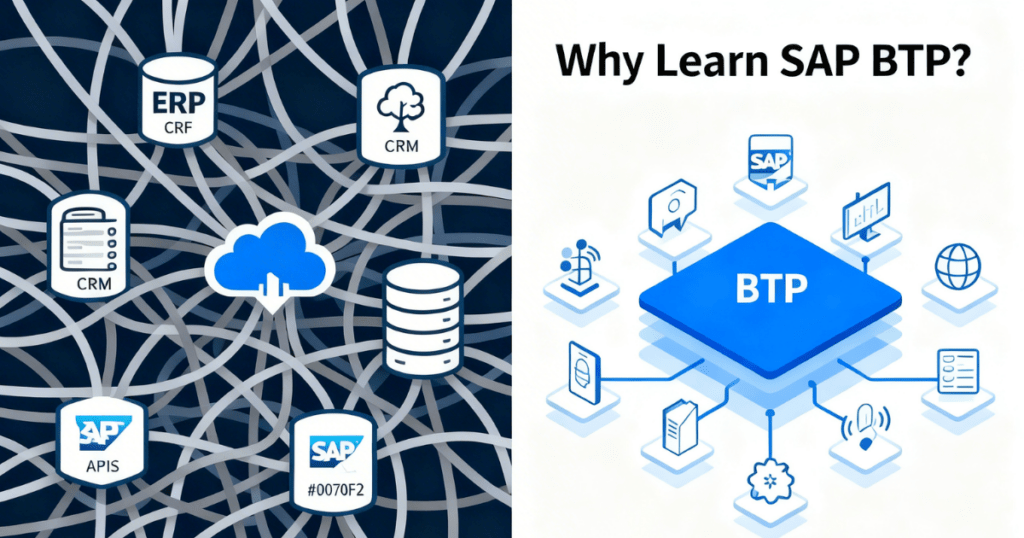
Companies running SAP are no longer just maintaining legacy ERP systems. They're connecting those systems to cloud services, building custom applications, automating integrations, and embedding AI into their business processes. The platform making all of that possible is SAP BTP — and organizations are adopting it faster than the talent market can keep up.
That gap is your opportunity.
Whether you're a student entering the job market, a developer coming from AWS or Azure, or a project manager overseeing enterprise rollouts, understanding why to learn SAP BTP — and which practical skills to focus on first — can meaningfully change your career trajectory.
What Exactly Is SAP BTP (Without the Jargon)
SAP Business Technology Platform is a unified, cloud-based platform that combines four core capabilities: data management, analytics, application development, and integration — all in a single environment that connects directly to SAP systems and third-party applications.
Think of it as the operating layer on top of SAP's ecosystem. If SAP S/4HANA is the engine running your business, BTP is the control panel that lets you extend, connect, and customize it without rewriting the core.
The four pillars break down like this:
- Database & Data Management — storing, processing, and governing enterprise data using SAP HANA Cloud
- Analytics — building dashboards, reports, and predictive models with SAP Analytics Cloud
- Application Development — creating business apps with low-code tools like SAP Build
- Integration — connecting SAP systems with external APIs, ERPs, and cloud services through Integration Suite
The important thing to understand: you don't need to master all four to be useful on a project. Most professionals start with one pillar and expand from there.
Who Should Actually Learn SAP BTP
IT Students and Career Switchers
If you're entering the job market, SAP BTP is one of the most strategic skills you can add to your resume right now. The reason is simple: demand far outpaces supply. Most universities don't teach it, and most bootcamps ignore enterprise platforms entirely. That creates a real opening for self-taught professionals who take the initiative early.
Entry-level roles like BTP developer, integration consultant, and SAP Build specialist are actively being posted — and they pay well, even at the junior level.
SAP and Non-SAP Professionals
If you already work with SAP — as a functional consultant, ABAP developer, or Basis administrator — BTP extends your existing knowledge into cloud-native territory. Your understanding of how SAP systems work is a genuine advantage when learning to connect, extend, and build on top of them.
If you're coming from a non-SAP background — working with Java, Python, AWS, or Azure — the transition is more about context than raw technical skill. Most BTP tools use REST APIs, standard cloud concepts, and visual development tools that feel familiar. What you'll need to learn is how SAP's ecosystem is structured and why enterprises rely on it so heavily.
Systems Architects and Project Managers
You don't need to write code to benefit from understanding SAP BTP. Architects and PMs who understand the platform make better decisions — about scope, timeline, integration risk, and vendor selection. Knowing what BTP can and can't do natively versus what requires custom development is the kind of knowledge that prevents expensive mistakes during project design.
The Minimum Practical Skills to Start Working with SAP BTP
Here's the key insight most training programs miss: you don't need to know everything to start contributing on a real project. You need a working foundation in a handful of core areas.
BTP Cockpit Navigation
The BTP Cockpit is your command center. Understanding how global accounts, directories, and subaccounts are structured is step one — because every action you take in BTP happens within this hierarchy. Before you build anything, you need to understand where you are and how different environments (development, testing, production) are organized.
Integration Suite Basics
SAP Integration Suite is one of the highest-demand skills on the platform. At minimum, you should understand what integration flows (iFlows) are — visual representations of how data moves between systems — and be able to read, modify, and deploy a simple one.
Real projects almost always involve integration, which means this skill makes you immediately useful.
SAP Build — Low-Code App Development
SAP Build lets you create business applications without deep programming knowledge. For career switchers and project managers, this is the fastest way to produce something tangible using BTP. For developers, it's a rapid prototyping tool that can be extended with custom code when needed.
Being able to build even a simple workflow or form-based app demonstrates practical, hands-on capability.
Understanding Destinations and Connectivity
Destinations are how BTP connects to external systems — whether that's an on-premise SAP system, a third-party CRM, or a REST API. Understanding how to configure and troubleshoot destinations is a foundational skill that touches almost every BTP project, regardless of which pillar you're working in.
SAP BTP vs. Other Cloud Platforms — Should You Learn This Instead of AWS or Azure?
This is the wrong question — but it comes up constantly.
SAP BTP is not a replacement for AWS, Azure, or GCP. In fact, BTP runs on top of those hyperscalers. What SAP BTP does is provide a purpose-built layer specifically designed for SAP-centric enterprise environments — with pre-built connectors, native integration with SAP systems, and business process awareness that generic cloud platforms don't have out of the box.
For organizations running SAP — which includes a significant portion of the Global 2000 — having someone who understands BTP specifically is more valuable than having someone who only knows generic cloud services. The salary data backs this up: SAP BTP consultants consistently command higher rates than general cloud engineers in enterprise environments precisely because the skill set is more specific and harder to source.
How to Start Learning SAP BTP Without Getting Overwhelmed
The most common mistake beginners make is trying to learn all four pillars at once. Don't.
Start with a free BTP trial account — SAP offers a Free Tier that gives you hands-on access to the real platform, not a simulation. Then pick one pillar based on your background: Integration Suite if you're technical, SAP Build if you're coming from a business or project management role.
If you want a structured path that cuts through the noise, the SAP Business Technology Platform for Everyone course at Michael Management is specifically designed for professionals at exactly this stage — covering the essentials across the platform without requiring prior SAP experience.
The milestone to aim for: “Can I understand what's happening on this project and contribute to one workstream?” That's what gets you on your first BTP engagement. Everything else builds from there.
The Bottom Line — Is SAP BTP Worth Your Time?
If enterprises are your market — and for most IT professionals, they are — then SAP BTP is one of the most high-value, under-supplied skills you can invest in right now.
The opportunity isn't theoretical. It's measured in open roles, project demand, and compensation premiums that are available today because most professionals haven't made the move yet.
Start with the fundamentals. Get hands-on fast. And don't wait until the market catches up.
👉 Ready to begin? Start with a structured introduction: SAP Business Technology Platform for Everyone